Thursday, November 30, 2023

Leaders Serve


Servant Leadership is a growing field of academic study with entire leadership conferences and organizations dedicated to its development and understanding.  It has become very 'in' and stylish, almost to the point of being chic.  Don't get me wrong, servant leadership is a powerful concept and I truly believe that the most effective leaders are servants first in that their responsibility is to serve their team and its members.  I am; however, very concerned that it has become almost blasé to the point where it is not really understood what it truly means to be a servant leader and to serve other as their leader.

I would posit that true servant leadership starts as an attitude.  It is a mindset, it is a world view, it is a set of lenses from which to view the world.  In a sense, it is a calling.  Servant leaders operate from a standpoint that their purpose is to serve people one person at a time.  History has a plethora of leaders whom we would call servants: Jesus of Nazareth, Harriet Tubman, Abraham Lincoln, Mother Teresa, Mahatma Gandhi, Martin Luther King, Jr., Nelson Mandela, and the list goes on.  They were either leaders who served or servants who led; or both!  Serving was in their DNA!

That then begs the question, "Are servant leaders just born?".  I would argue NO.  While the above list would seem to support the proposition that servant leaders are born, one only has to read Louis Fletcher's The Life of Mahatma Gandhi to understand the transformation that Gandhi underwent to become the icon that is almost revered today.  The same can be said for almost anyone else on this list.  Today there is overwhelming consensus that leaders are and can be made.  The Great Man theory of leadership has been all but debunked over time.

Serving is an essential component of leading.  It is not complicated.  It can be developed through deliberate actions with the right heart and attitude.

I have shared this story before but revisit it here as it is pertinent to the point I am making.

Arguably the greatest coach of all time in any sport, and most certainly college basketball, was the late John Wooden.  Coach Wooden is famous for his 10 NCAA National Championships, 88 victories in a row, and his iconic Pyramid of Success.  Coach Wooden was THE MAN!!!  And yet, he was a very humble servant who believed that he did not coach basketball as much as he developed young men of character who played basketball.  It would not have been surprising if he had become somewhat inflated with his own success and self importance, and yet he didn't.  Coach Wooden instilled in his players that if they did their best and gave 100 % consistently throughout practice and games, the winning would take care of itself.

Coach Wooden's UCLA teams won 10 NCAA National Basketball championships in 12 years between 1963 and 1975 including 7 in a row between 1967 and 1973,  In that span, the Bruins won an astounding 88 games in a row.  Impressive.  Wooden was a natural!  Not so fast...  Coach Wooden's first season at UCLA was the 1948-49 season.  From 1948 to 1963 UCLA was competitive, but not dominant.  Coach Wooden was molding a program.  He was teaching and modeling success that would and did pay off in the end.  So why did I give you that extensive back ground on this great coach?  During his time at UCLA, especially in the early years, it was not uncommon to find Coach Wooden sweeping the gym floor!  Why??  According to him, "because it needed to be done.".  Let that sink in... the greatest coach of all time was frequently found sweeping the gym floor because it needed to be done.  It was not beneath him.  He served and did what needed to be done.  That is servant leadership!

So my challenge is this: ask yourself how can you serve?  What needs to be done that you can do?  How can you help and support your team and its individual members.  Be sincere... WANT to help and serve and you will be amazed at the results.  

Servant leadership is effective leadership!

Wednesday, November 29, 2023

Leaders Create a Healthy Environment


If you have been around long enough, you will have experienced a variety of work cultures and environments: some good, some not so good!  The good ones are fairly easy to identify.  People want to be there and work there and they feel good about the place and the people with whom they work.  The not so good ones breed complaining, apathy, anxiety, stress, tension, and/or a variety of other negative feelings and emotions.  They cause people to really not want to be there.

There is a general consensus among leadership pundits that the leader is, at least in part, responsible for the culture and work environment.  Effective leaders strive to create a work place where people feel valued, important, and productive.  This is a win-win.  On the one hand, people who feel positive about their work environment will be more productive, will work harder, and will strive to do their best and go the extra mile to get things done.  The other side of this is that the leader and the organization benefit by having higher productivity and a stellar reputation.  It becomes a place where the best and the brightest want to go to work and be part of a winning team.

As a leader it is your responsibility to create a positive environment.  This does not mean that everybody always gets their way.  I once worked for a supervisor whom I greatly respected because of the environment that was created.  I did not agree with every decision that was made by them, but, I ALWAYS felt that I was heard.  That's leadership.  That's creating a positive environment.  That is what it is all about!

Tuesday, November 28, 2023

Leaders are Helpful


In recent years there have been countless volumes of books and articles written on leadership.  Even the noted management guru Peter Drucker who, in his early writings downplayed the importance of leadership in favor of strong management, came to posit that strong leadership had a much more important role than he had previously indicated.  The field is now rich with leadership practitioners such as John C. Maxwell, Simon Sinek, Orrin Woodward, Chris Brady, and Jack Welch, to name a few, and leadership academics such as Warren Bennis, Carol S. Dweck, Angela Duckworth, Paul Hersey, James M. Kouzes, Barry Z. Posner and many others all contributing to the body of knowledge on leadership and/or some component of leadership development.

Yet, effective leadership alludes too many individuals and organizations.  Many individuals continue to ascend to leadership positions for all the wrong reasons.  They may be ego driven, seeking greater financial gain, craving a sense of increasing power, or been in the wrong place at the wrong time and had a position 'dumped' on them that was unwanted and for which they were not ready.

As we continue to unpack our understanding of effective leadership, I will continue to deal with leadership components and issues one by one.  In some cases there will be patterns and a clear connected path; in other cases it may seem that I am just pulling items at random.  Both will be true.

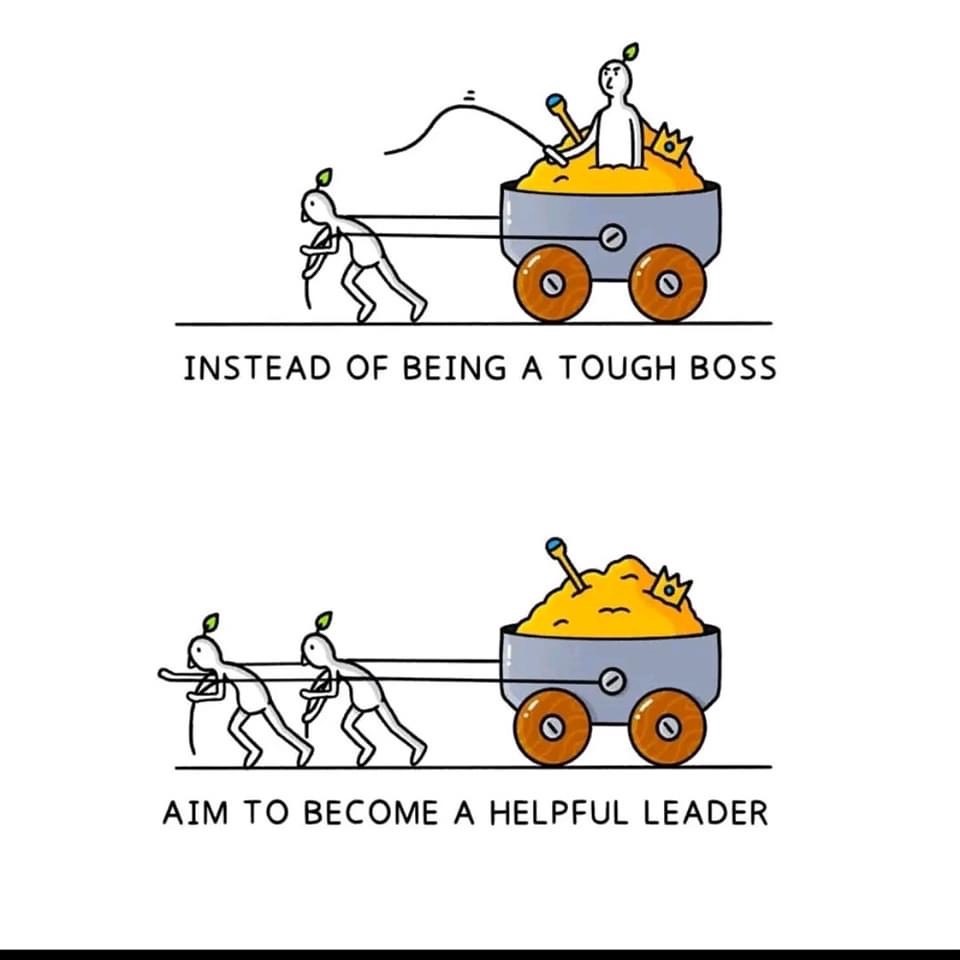
Today, a friend and colleague sent the above meme to me with the note "Here's one for u to post".  The more I looked at this simple message, the more the deeper meaning of the message hit me. The graphic below does a good job of introducing the concept of recognizing the difference between a boss and a leader.


I want to concentrate on the top graphic.  We have all had bosses who made it very clear that we worked FOR them and not WITH them.  They dictated tasks, rarely gave credit, hardly ever said thank you, and created a tense, if not toxic, work environment.  To be the BOSS they had to be tough!  Contrast that with the leaders with whom it has been our privilege to work.  They always ask for things to be done, quickly give credit and take blame, frequently offer sincere thanks, and always seek to create a caring and nurturing work environment.  They are there to help and support.  To be the LEADER they were by nature helpful!

Effective leaders build relationships, gain trust, and create a healthy work culture and environment where people feel valued and appreciated.  They are all about we and not me.

Aim to be that leader!


Monday, November 27, 2023

Reading Like a Leader


Previously I made the point that reading as a leader is different.  Leaders read to grow and develop, not just to be informed.  This requires reading through a different lens, so to speak, that is, reading through a leader's lens.

 
The best book I have ever read on reading as a leader is Turn the Page: How to Read Like a Top Leader.  If you have not read it, I highly recommend that you do.  Here is a link where you can purchase it.
 
While I will not outline the entire book here, I will offer these highlights that made a tremendous difference to me.

1. Leaders read differently.

Leaders are less concerned with the mere knowledge of a million facts than they are with the internalization and application of real principles and solutions.  Leaders read to learn what they need to know, do, or feel, regardless of the author's intent or words.  As they read, they search for answers to questions, great examples of leadership, and whatever else they may need in their leadership journey and mentorial relationships.... Leaders see past the words and read with the specific intent of finding truth and applying it directly in their own lives. (1)
 
2. Write in your books.
 
This was a hard one for me as I have always revered books and treated them as items of very high value.  Writing in them seemed wrong as I felt that I was somehow desecrating the book.  I was wrong.  Reading is NOT a one way static activity: I read the book; I get information.  Rather, leaders know that reading is, in fact, an interactive process of receiving and giving.  Top leaders read, underline, highlight, and make notes in the margins.  I came to understand that this was not desecration but rather an essential practice for leadership development.

3. Argue with the author

Too many people read books and take the content as gospel.  Leaders read to learn and broaden their minds, but that does not mean that they always have to agree with everything they read.  It is possible to read something, ponder and consider it, and conclude that the author is wrong!  The important key here is the 'ponder and consider' step.  Leaders know and accept that there are differing views; they also know that they do not have to agree with them all.  I have read countless books where I disagreed with some of all of the author's content.  I grew, as it caused me to think through my belief system and strengthened the logic of my position.

4. Reading provides mentors

If you read enough, you start to develop a list or authors who literally speak to you.  These authors become mentors.  There are times when I read something from one of my favorite authors that I just know that they were writing it to and for me: well not really, but it does seem like it because the impact is so powerful and poignant.  My favorite authors include John C. Maxwell, Orrin Woodward, Chris Brady, Simon Sinek, David McCullough, and Theodore Sizer.  Personally, I love reading biographies.  I find the lessons from history are legion.  Recently I have been reading works by Peter Drucker.  Drucker was brilliant but, to me, an acquired taste.  I don't think I was ready for him earlier in my life and career, but now am at a point where I can appreciate the utter genius of his thoughts and writings.  You should and will have the same experiences, but only if you read, and read regularly!

I could go on and on with nuggets from this book.  It is a short book (142 pages) and can be easily read in an afternoon, but you shouldn't!  Don't just read it, study it, reread it, digest it, reread it, internalize it, and then reread it!  If you implement the principles found in this this book, it WILL make you a better leader!

(1) Turn the Page: How to Read Like a Top Leader pg.15


Sunday, November 26, 2023

Leaders are Readers

In my previous post I submitted that effective leaders are constantly learning.  I stated that leaders are readers and that I would cover that in detail in this post, so here we go!

The relationship between reading and success is well documented.
 
-- When asked for the key to his success, Warren Buffet is quoted as saying "I just sit in my office and read all day."
 
-- Teddy Roosevelt's reading habits are, if not a bit exaggerated, legendary.  It is reported that he read at least a book or two a day.  Whether or not this is true, the fact remains he was an avid reader and credited much of his success to reading.

-- When asked how he learned to build a rocket, entrepreneur and SpaceX founder Elon Musk is reported to have replied "I read books.".

-- Abraham Lincoln had only one year of formal education, yet, taught himself through reading.
 
Pulitzer Prize winning author David Herbert Donald in his biography of Lincoln relates:

Even more important was the ability to read.  Once he got the hang of it, he could never get enough.  "Abe was getting hungry for book[s]," Dennis Hanks recalled. "reading every thing he could lay his hands on."  He would carry a book with him when he went out to work, and read when he rested.  John Hanks remembered that when Abraham returned to the house from work, "he would go to the cupboard, snatch a piece of corn bread, take down a book, sit down in a chair, cock his legs up as high ad his head, and read." (1)
 
Donald goes on to describes in detail the importance of reading to Lincoln's eventual success. 

The list of successful people who attribute their success, at least in part, to reading goes on and on!


So, if leaders are readers, the question begs to be asked, what should leaders be reading to grow and improve?  What may seem obvious, really is not.  Intuitively, one may think that reading technical materials on one's profession is what it is all about.  Not entirely.  While it is important to stay current on your given field (most professions require continuing education), there is so much more.
 
 
New York Times best selling author and CEO Chris Brady shares that he has multiple books that he is reading at any given time.  He reads a variety of genres: leadership, history, economics, business, classic fiction (he shares that he read all of Tolstoy's War and Peace on his phone), personal development, etc.  Leaders do not limit themselves to one area of reading.  Effective leaders want and need to broaden their horizons by what they read.  As they improve, so will their team and their organization.


Reading is essential to the continuing development of any effective leader.  Leaders read to learn, they read to grow, and they real to lead!

 Next, we will delve into how a leader should read.  Reading as leader is different.  Stay tuned!

(1) Donald, D.H. (1995). Lincoln p. 30


Saturday, November 25, 2023

Leaders are Learners


Leaders are learners... seems logical and intuitive, yet, there are too many people in positions of leadership who really do not set learning as a specific goal or objective.  They will tell you that 'of course' they are always learning, and yet, they more or less just let learning happen without any specific intent.

Effective leaders set an agenda for themselves to learn.  Leaders are readers (we'll cover this in detail in the next posting).  Leaders are always looking for ways to learn.  Association is a key component of learning.  
 
Every American at one point or another, has been introduced to Benjamin Franklin.  The accomplishments of Franklin's life are well know: writer, businessman, entrepreneur, diplomat, scientist, patriot, founding father, and philosophical sage.  The thing that has always impressed me the most about Franklin's in his life long quest for learning and self improvement.  
 
During his printer era, Benjamin Franklin formed a 'club' of like minded fellow tradesmen that was commonly called the Leather Apron Club, also known as the Junto.  In his bestselling biography of Franklin, Walter Isaacson puts it this way:

Franklin's small club was composed of enterprising tradesmen and artisans, rather than the social elite who had their own fancier gentlemen's clubs.  At first, the members went to a local tavern for their Friday evening meetings, but soon they were able to rent a house of their own.  There they discussed issues of the day, debated philosophical topics, devised schemes for self-improvement, and formed a network for the furtherance of their own careers. (1)
 
In his autobiography, Franklin himself writes:

... I had form'd most of my ingenious acquaintance into a club of mutual improvement which we called the JUNTO; we met on Friday evenings.  The rules that I drew up required that every member, in his turn, should produce one of more queries on any point of Morals, Politics, of Natural Philosophy, to be discuss'e by the company; and once in three months produce and read an essay of his own writing, on any subject he pleased.  Our debates were to be under the directions of a president, and to be conducted in the sincere spirit of inquiry after truth, without fondness for dispute, or desire for victory... (2)
 

Franklin's quest for learning and self improvement were unending.  Franklin went on to develop his 13 Virtues, which he would work on throughout his life.  Franklin was a leader who understood that leaders are always learning and that learning is a lifelong endeavor. 

 
To be truly effective, leaders MUST continue to learn.  The great leaders have a learning plan that is a designed part of their regular routine.
 
(1) Isaacson, W. 2003. Benjamin Franklin: An American Life p. 55 
(2) Franklin, B. 1996/1868 The Autobiography of Benjamin Franklin p. 45 (Dover.Thrift.Editions)

Thursday, November 23, 2023

Trust


Trust.  Trust is that critical component of character that takes a very long time to establish, can be instantly destroyed and lost, and, frequently, can never be recovered!

If a leader is going to be effective, building trust is essential!  

Stephen M.R. Covey puts it this way:

There is one thing that is common to every individual, relationship, team, family, organization, nation, economy, and civilization throughout the world-- one thing which, if removed, will destroy the most powerful government, the most successful business, the most thriving economy, the most influential leadership, the greatest friendship, the strongest character, the deepest love.

On the other hand, if developed and leveraged, that one thing has the potential to create unparalleled success and prosperity in every dimension of life.  Yet, it is the least understood, most neglected, and most underestimated possibility of our time.

That one thing is trust. (1)

Covey goes on to break down trust into various arenas, what he calls waves, and offers a series of behaviors that are essential to building trust.  If you have not read his book, you should!  Every leader should have this tome in his or her library and read it, and reread, it regularly!

The reality is that trust, or lack thereof, can and will make or break a leader.  In order to lead, I mean really lead, one must establish and have the trust of their team.  


Trust is one of those things that cannot be demanded of people, it must be earned... and earning it takes time and patience.  The effective leader will work, and work hard, to establish trust.  Trust is a result of the leader's actions, and those actions must be a sincere and deliberate effort to build effective relationships, do the right things to the best of your ability, and to put others first by serving and supporting them.

A leader can only say "Trust me" and have people actually trust them if they have built and earned that trust over time with positive and effective actions.  The leader who neglects to establish trust from their team is finished before they even start.

(1)  Covey, Stephen M.R., The Speed of Trust:The One Thing That Changes Everything  p.1